Photo bombs and Facebook quizzes for serious journalists

David Poulson serves an unusual community and has some wacky ideas about how to provoke them. As he wrote for the Knight Citizen News Network, “Try poking your community with a sharp stick and challenging it to interact.”

David’s site, Great lakes Echo, is based at Michigan State University’s Knight Center for Environmental Journalism and is the successor to Great Lakes Wiki.

He works with students on on the site, which defines a community around natural resources rather than political boundaries. Their coverage area covers eight states and two Canadian provinces. David says he thinks of it like a “news shed” rather than a “watershed” and is trying to build connections between people who do — or at least should — have a huge thing in common. He says he’s seen how news can be a unifying concept, and he wants to bring a small town “we’re in this together” mentality to his environmental coverage.

Continue reading “Photo bombs and Facebook quizzes for serious journalists”

Engagement makes for happy customers (and other wisdom from Chrys Wu)

Chrys Wu is a journalist-turned-user engagement strategist. When I called to ask her what engagement is and how journalists can achieve it, she offered stellar nuggets of wisdom. I’ll share a few here.

— Engagement (and, really, we should use more specific words so we know what we’re talking about) is about the things we do to develop a relationship between us and the people who are interested in what we’re doing. It’s not just about pushing out content.

— Engagement forms an emotional bond between you and your community. Think of it as developing a good customer relationship. “If you do engagement well, however you define it, what you’re essentially doing is creating happy customers,” Chrys says. “When people have an attachment to you, they’re less likely to leave” when presented with other options. Help them feel something about what you’re doing.

— Offline and online engagement can be seamless, if you have a community that’s interested in what you’re doing. Your strategies for connecting with them may not be the same online and off, but your motivation for creating relationships might be consistent.

— If you have limited staffing, don’t feel like you have to be everywhere your users are. Be strategic about how and where you spend your time.

— Understand that there are lots of valid ways to communicate. Don’t be fooled into thinking there’s One Right Way, for social media in particular. There are cultural norms that are good to be aware of, but there’s no single recipe for success. If someone tells you you’re “doing it wrong,” don’t conform without giving it some thought. Make sure you’re meeting your objectives and the needs of your community, then don’t worry about what others think.

— For engagement efforts to work, cultural changes have to be company wide. One person dancing alone does not make an organization more engaged with its community.

This was originally posted on the blog of the Reynolds Journalism Institute, where I am a 2010-2011 fellow.

Journalists, it’s time to date your readers

During a Skype chat, Mashable’s very smart community manager, Vadim Lavrusik, mentioned that part of the challenge of real engagement is learning what makes your audience tick. We have to get a sense of what they like, and what they respond to in us.

To me, what he was describing sounded like dating, in the get-to-know-you phase. You’re entering into a relationship with your audience, and you have to figure out what times of day they prefer which sorts of activities, what makes them mad, what makes them want to curl up and spend time together.

Continue reading “Journalists, it’s time to date your readers”

What “engagement” means to The Guardian’s Meg Pickard

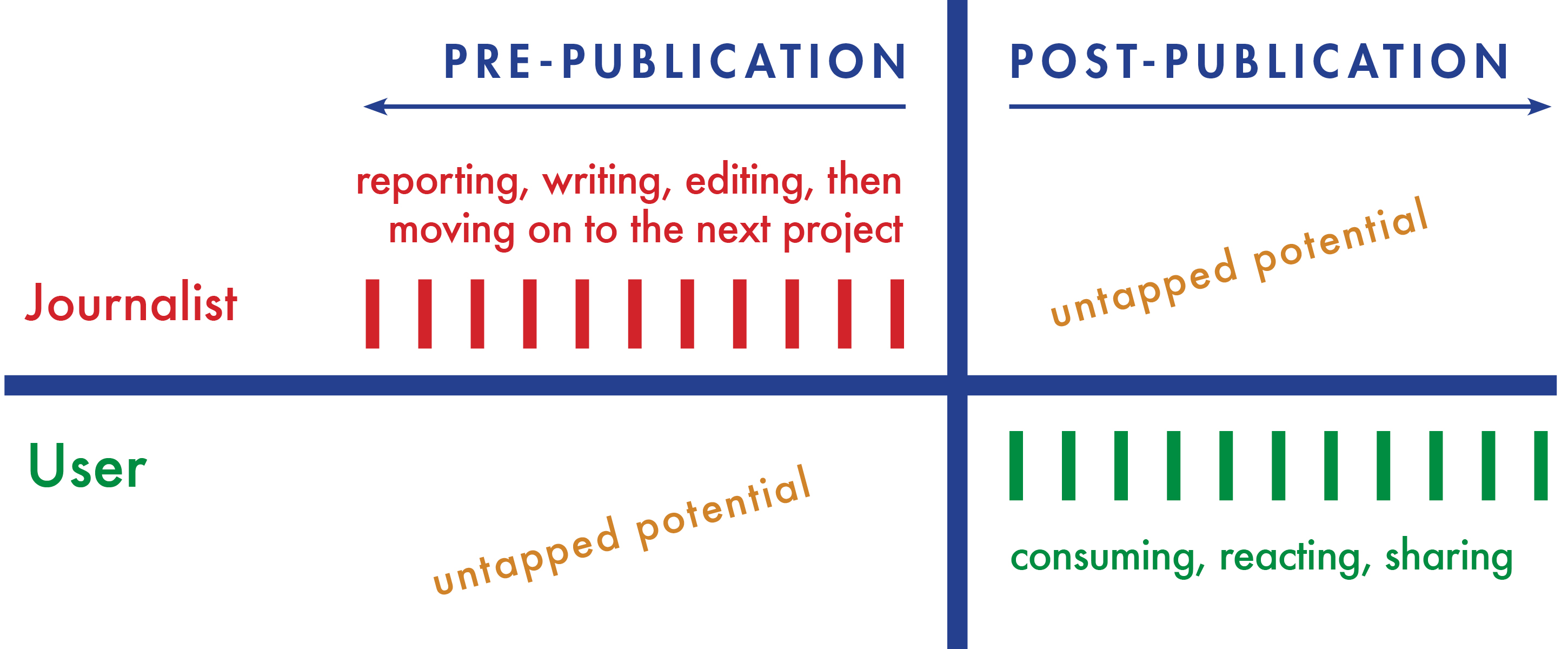
Meg Pickard, The Guardian’s head of digital engagement, has a little diagram that gets so perfectly to the heart of this thing we call engagement that I giggled through her explanation of it, so amazed at its crystal clarity.

The horizontal line is the process of journalism. The vertical line represents publication. Above the line are the actions of journalists. Those folks traditionally work really hard up until publication, then return to the beginning to start something new. Below the line are the users, whose role has always come after publication, reacting and sharing.

The other two quadrants are empty. And that’s where Meg’s work lies.

Joy’s recreation of Meg’s drawing

After publication, how can/should journalists stay involved with the content? What’s their responsibility or opportunity for tending the fire they started? For raising the child they birthed? For nurturing the community they fed?

Before publication, how can/should users be involved? How can their interests, insight and expertise shape what we do? How can they contribute to conversations, and to stories?

Continue reading “What “engagement” means to The Guardian’s Meg Pickard”

Analytics stoplights for Belo’s TV stations

My second of two posts this week on using web analytics (read the first one here) comes by way of a recommendation from Mark Briggs. He told me about this “total brainiac engagement person” at Belo, the company that owns the TV station Mark now works for.

So I called Belinda Baldwin, the director of audience development for Belo. Belinda’s goal is to take the metric reports that her department creates for all Belo owned and operated TV stations, and make it understandable for newsrooms. Not just understandable, but meaningful and actionable.

Continue reading “Analytics stoplights for Belo’s TV stations”

Check the analytics: Your users are talking to you

During my fellowship year, I hope to not only figure out what engagement is but start to chip away at how we as journalists know if we’re achieving it.

Measuring presents plenty of challenges, not the least of which is assessing qualitative, not just quantitative, factors. How can I “measure” user comments? (Definitely not just by number.) How can I “measure” in-person conversations? How can I “measure” listening?

There are some things, though, that we can measure. I’ve written just a bit about social media analytics. I’m going to expand the analytics conversation here, based on what I’ve learned from some smart people.

Continue reading “Check the analytics: Your users are talking to you”

What “engagement” means to the Chicago Tribune

My conversation last week with James Janega at the Chicago Tribune surprised the heck out of me. After spending several weeks interviewing folks at small community operations, I expected my interviews with with large organizations like the Tribune to be more like the one I had with the Associated Press, whose focus is on social media strategies.

Nope. The Chicago Tribune is all about face-to-face interactions.

James is the manager of Trib Nation, which is the paper’s blog and the umbrella for outreach efforts. He says his job is to build bridges between the newsroom and its communities. For James, that means being in constant conversation with readers — with an emphasis on listening — and doing that primarily in person.

Continue reading “What “engagement” means to the Chicago Tribune”

What “engagement” means to Lauren McCullough at the Associated Press

How do you build a relationship with a global audience, personalizing a brand and involving users in your coverage? The Associated Press is going for it, with aggressive social media strategies and a reliance on its 3,000 journalists.

“Fundamentally, we think people want to interact with people,” says Lauren McCullough, the AP’s manager of social networks and news engagement. Lauren and her team try to personalize the AP’s corporate accounts, revealing who’s behind them and using initials in the tweets, but “at the end of the day, we’re three people in New York.” That’s why a cornerstone of the company’s social media strategy is training the individual journalists on the benefits and practices of social media and hoping they feel comfortable enough to embrace it and run with it.

Continue reading “What “engagement” means to Lauren McCullough at the Associated Press”

What “engagement” means to Honolulu’s Civil Beat

John Temple, editor of the Civil Beat (and formerly of the Rocky Mountain News), poses this question: How do you behave when you’re a trusted friend? On John’s staff, the people known as “reporter/hosts” are working to build relationships with readers, and a relationships involves sharing information about themselves and being present in their coverage.

“Readers actually do want (reporters) to tell it like it is, tell them what it means, cut to the quick,” John says. His staff has heard that refrain from readers enough that they’re seeing the value in it. “It’s made them more comfortable over time with a combination of news and opinion.” The reporter/hosts spend most of their time reporting, but they’re also charged with interacting meaningfully with readers, online and in person.

The seven-month-old Civil Beat doesn’t accept advertising and is built on a membership model. President Randy Ching (formerly of eBay) said the goal was to invest in investigative journalism in a commercially sustainable way. They want to build a product people value and are willing to pay for. Non-members can read discussions, and they have access to some articles free. Membership options include $1.49 for a single day and $19.99 for a month.

So, how do you go about becoming the readers’ trusted friend? Here are some strategies that Randy and John (in separate Skype interviews) shared:

— Participate in conversation, listening as well as talking. The online discussions and comments are treated as a priority. Staff members answer questions and clarify points raised by members. They behave in a way that sets the tone for the conversations. Randy says they’re also encouraged to share their own perspective and analysis — not to convince people to agree with them but to be transparent about what they believe. John talks about transparency in terms of not pretending the reporters weren’t there. He used the example of a war correspondent who is less concerned with balance than with painting a realistic, personally observed picture. “(Readers will) actually read the same sort of report about city hall,” he said. “We’re definitely present in our articles and in our stories … I’ve never seen any traditional news organization do what we do.” (Find the Civil Beat at @CivilBeat or #becivil on Twitter.)

Continue reading “What “engagement” means to Honolulu’s Civil Beat”

What “engagement” means to The Terminal and Andre Natta

Kathleen Majorsky is a Mizzou masters student. She is fascinated by new media, and this is her second involvement with an RJI project. She is working with Joy Mayer this semester on how information providers define engagement. She interviewed Andre Natta and wrote this post.

The Terminal, a hyperlocal news site in Birmingham, Ala., is relaunching later this month to try new ways to tell the city’s stories, and Publisher and Managing Editor Andre Natta says one of his motivations is to increase his engagement with the community.

“I think engagement means building a relationship with the community that likes your site. It is thinking of ways to make it easier to have those conversations, whether they are online or offline,” Natta says.

Continue reading “What “engagement” means to The Terminal and Andre Natta”