At the crossroads of journalists and librarians, we find community engagement

I’ve been at an inspiring workshop the last day and a half. Beyond Books, sponsored by Journalism That Matters and RJI, among others, brought together librarians, journalists and activists. You can see the program, the session recaps and a list of attendees online.

The basic idea is that these groups of people share a common mission of improving their communities through information. Say all you want about journalistic cynicism and profit-chasing. I believe most of the journalists I’ve had the pleasure to work with would say they got into the news biz because they feel like it’s a way of making the world a better place, whether they’re doing that by improving democracy or building connections through storytelling.

Continue reading “At the crossroads of journalists and librarians, we find community engagement”

Data! About conversational journalism!

One of the struggles in talking about relationships between journalists and their audiences is that we too often stay philosophical and talk from our gut.

This morning at South by Southwest, Doreen Marchionni presented her dissertation research on how audiences perceive conversational news. I’ve talked to Doreen about her work before and have learned a lot from it, but I haven’t written about it. I apologize to her for the brevity of this post — her work deserves much more detail.

These are the variables that her research attached to the idea of conversational journalism, which she defines as a deeply collaborative relationship between journalists and audiences. Conversation consists of:

Continue reading “Data! About conversational journalism!”

What “engagement” means to Zach Seward at the Wall Street Journal

Zach Seward is the outreach editor at the Wall Street Journal. When you’re at an organization as large as the Journal, your relationship with your audience is going to necessarily look quite different from those at smaller shops. But I’ve talked this year to some other large newsrooms (including the Associated Press, NPR and the Chicago Tribune) and have found a lot of variety in their approaches as well.

Zach’s name has come up over and over as I’ve asked folks for interview suggestions, and I was glad to get a chance to ask him some questions about his job, his newsroom and his audience. Here’s what Zach had to say:

ON SOCIAL MEDIA BRAINSTORMING: Part of Zach’s job is to talk to reporters and editors about possible social elements to accompany individual projects. He says he approaches those from a neutral standpoint, rather than one of persuasion or evangelism. He allows for the possibility that a social component doesn’t make sense and tries to be more consultant than cheerleader. He says that approach suits his own personality and is consistent with the healthy skepticism journalists often wear. He doesn’t want social media to suffer from over-hype and to feel like a bandwagon every reporter’s got to jump on.

Continue reading “What “engagement” means to Zach Seward at the Wall Street Journal”

Engagement is a mindset, not a series of activities

I’ve been saying all year that journalists have a lot to learn from other industries and disciplines. Never have I felt more fired up about that than when talking to Jake McKee last week.

Jake’s background is in online communities and customer collaboration. He was suggested to me by The Guardian’s Meg Pickard (an anthropologist by training) as someone who could help me learn about community organizing and community management. From his bio: “Jake helps organizations understand how to act like groups of people, rather than soulless money making machines.”

Sign me up.

Continue reading “Engagement is a mindset, not a series of activities”

Photo bombs and Facebook quizzes for serious journalists

David Poulson serves an unusual community and has some wacky ideas about how to provoke them. As he wrote for the Knight Citizen News Network, “Try poking your community with a sharp stick and challenging it to interact.”

David’s site, Great lakes Echo, is based at Michigan State University’s Knight Center for Environmental Journalism and is the successor to Great Lakes Wiki.

He works with students on on the site, which defines a community around natural resources rather than political boundaries. Their coverage area covers eight states and two Canadian provinces. David says he thinks of it like a “news shed” rather than a “watershed” and is trying to build connections between people who do — or at least should — have a huge thing in common. He says he’s seen how news can be a unifying concept, and he wants to bring a small town “we’re in this together” mentality to his environmental coverage.

Continue reading “Photo bombs and Facebook quizzes for serious journalists”

Engagement makes for happy customers (and other wisdom from Chrys Wu)

Chrys Wu is a journalist-turned-user engagement strategist. When I called to ask her what engagement is and how journalists can achieve it, she offered stellar nuggets of wisdom. I’ll share a few here.

— Engagement (and, really, we should use more specific words so we know what we’re talking about) is about the things we do to develop a relationship between us and the people who are interested in what we’re doing. It’s not just about pushing out content.

— Engagement forms an emotional bond between you and your community. Think of it as developing a good customer relationship. “If you do engagement well, however you define it, what you’re essentially doing is creating happy customers,” Chrys says. “When people have an attachment to you, they’re less likely to leave” when presented with other options. Help them feel something about what you’re doing.

— Offline and online engagement can be seamless, if you have a community that’s interested in what you’re doing. Your strategies for connecting with them may not be the same online and off, but your motivation for creating relationships might be consistent.

— If you have limited staffing, don’t feel like you have to be everywhere your users are. Be strategic about how and where you spend your time.

— Understand that there are lots of valid ways to communicate. Don’t be fooled into thinking there’s One Right Way, for social media in particular. There are cultural norms that are good to be aware of, but there’s no single recipe for success. If someone tells you you’re “doing it wrong,” don’t conform without giving it some thought. Make sure you’re meeting your objectives and the needs of your community, then don’t worry about what others think.

— For engagement efforts to work, cultural changes have to be company wide. One person dancing alone does not make an organization more engaged with its community.

This was originally posted on the blog of the Reynolds Journalism Institute, where I am a 2010-2011 fellow.

Journalists, it’s time to date your readers

During a Skype chat, Mashable’s very smart community manager, Vadim Lavrusik, mentioned that part of the challenge of real engagement is learning what makes your audience tick. We have to get a sense of what they like, and what they respond to in us.

To me, what he was describing sounded like dating, in the get-to-know-you phase. You’re entering into a relationship with your audience, and you have to figure out what times of day they prefer which sorts of activities, what makes them mad, what makes them want to curl up and spend time together.

Continue reading “Journalists, it’s time to date your readers”

What “engagement” means to The Guardian’s Meg Pickard

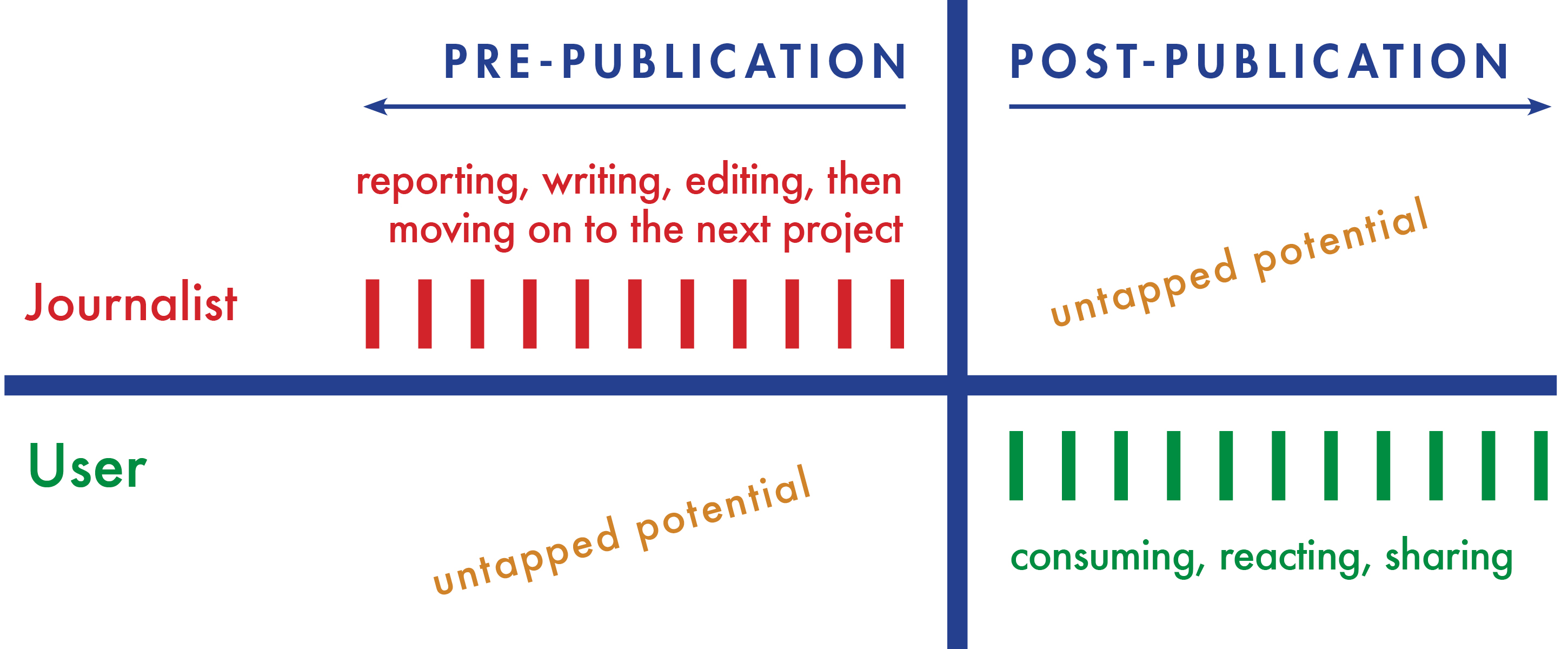
Meg Pickard, The Guardian’s head of digital engagement, has a little diagram that gets so perfectly to the heart of this thing we call engagement that I giggled through her explanation of it, so amazed at its crystal clarity.

The horizontal line is the process of journalism. The vertical line represents publication. Above the line are the actions of journalists. Those folks traditionally work really hard up until publication, then return to the beginning to start something new. Below the line are the users, whose role has always come after publication, reacting and sharing.

The other two quadrants are empty. And that’s where Meg’s work lies.

Joy’s recreation of Meg’s drawing

After publication, how can/should journalists stay involved with the content? What’s their responsibility or opportunity for tending the fire they started? For raising the child they birthed? For nurturing the community they fed?

Before publication, how can/should users be involved? How can their interests, insight and expertise shape what we do? How can they contribute to conversations, and to stories?

Continue reading “What “engagement” means to The Guardian’s Meg Pickard”

Analytics stoplights for Belo’s TV stations

My second of two posts this week on using web analytics (read the first one here) comes by way of a recommendation from Mark Briggs. He told me about this “total brainiac engagement person” at Belo, the company that owns the TV station Mark now works for.

So I called Belinda Baldwin, the director of audience development for Belo. Belinda’s goal is to take the metric reports that her department creates for all Belo owned and operated TV stations, and make it understandable for newsrooms. Not just understandable, but meaningful and actionable.

Continue reading “Analytics stoplights for Belo’s TV stations”

Check the analytics: Your users are talking to you

During my fellowship year, I hope to not only figure out what engagement is but start to chip away at how we as journalists know if we’re achieving it.

Measuring presents plenty of challenges, not the least of which is assessing qualitative, not just quantitative, factors. How can I “measure” user comments? (Definitely not just by number.) How can I “measure” in-person conversations? How can I “measure” listening?

There are some things, though, that we can measure. I’ve written just a bit about social media analytics. I’m going to expand the analytics conversation here, based on what I’ve learned from some smart people.

Continue reading “Check the analytics: Your users are talking to you”