Breeze Richardson of Chicago Public Media shares the power of metrics

The unbelievably smart and passionate Breeze Richardson of Chicago Public Media chatted with my Participatory Journalism class this afternoon. We talked about the engagement metrics she has set up, which she described beautifully in this RJI blog post, the need for a culture of assessment in newsrooms, and how to best effect organizational change.
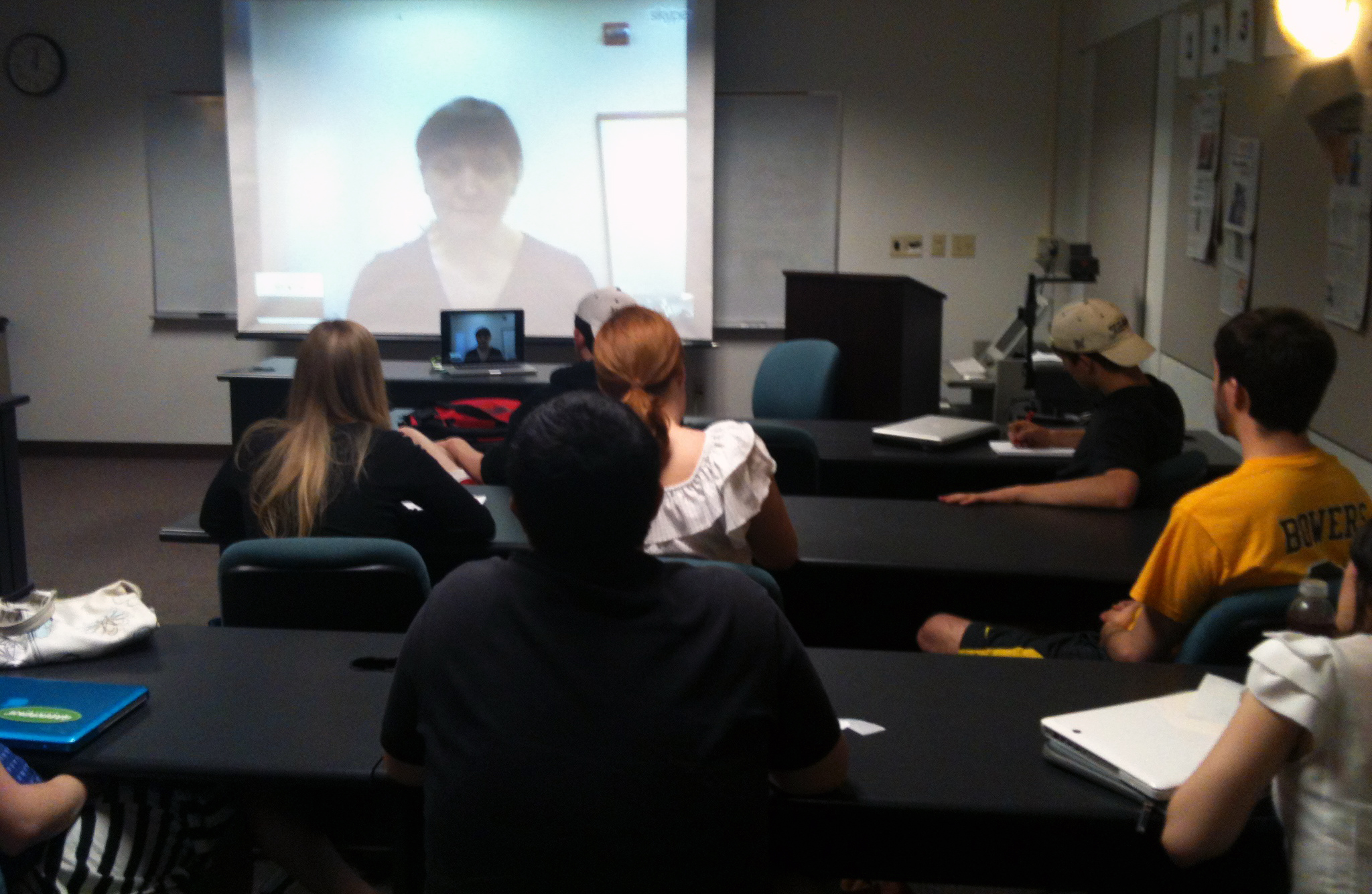
Breeze Richardson on engagement metrics
Participatory Journalism class at Mizzou, May 2, 2012

I always leave conversations with Breeze:

  1. Smarter
  2. Determined to change the culture of journalism
  3. Optimistic about opportunities for change
  4. Wondering if she’s hiring, because I’d love to work with her

I want to share just a few of the highlights from today’s conversation.

  • “If something is going to be institutionalized, it should be tracked and measured.”
  • Whenever possible, tie specific projects and efforts back to an organization’s strategic plan. If you have a mission that talks about bringing in more voices from the community, and you can tie specific efforts to that part of the plan, you have clear backup for your ideas. You also have a way to hold people accountable — something to point to that offers justification for the strategy.
  • Know what you’re tracking and what you’re not tracking, and track metrics that address your goals. This is another way of saying one of my favorite metrics mantras: The ROI of analytics data that lead to no action is zero. Track only what helps you make decisions.
  • Newsrooms are not used to being held accountable. Digital journalism has given us a window into audience, and being responsive to that audience is not always comfortable.
  • To reward people who focus on engagement, credit staff by name whenever possible. Don’t underestimate public praise as a motivator.
  • Think about what concrete steps reporters can take to make their stories engagement-friendly. This is one my newsroom is about to take on — a best practices guide for implementing the diagram on the wall of our newsroom showing the kind of journalism we value.

Be a Tigger not an Eeyore, and other job-hunting advice

In my Participatory Journalism class this week, we’ll be talking about how to get a job. We’ll start tomorrow with some basics of cover letters, resumes and interviewing. (Guests are welcome — we’ll be in Lee Hills 101A from 12-1:15.) Overall, though, the theme of the discussion will be about how we tell stories about ourselves — how we craft the narrative about ourselves that we want people to experience.

Here are a bunch of links I’ve saved related to job-hunting.

Here’s a smaller, curated list of the best ones for new grads. I made it last summer when I was teaching at the Poynter College Fellowship program.

So, what’s your story? Is it consistent across platforms? Do you have the quick version ready to go in case you find yourself in an elevator with your dream employer and have seven floors to make an impression? Do you have a longer one that makes for a killer cover letter? Do you have details to back it up for the interview conversation?

Continue reading “Be a Tigger not an Eeyore, and other job-hunting advice”

A note for student editors: There is life after major screwups

Some college newspaper editors here at Mizzou have landed in a heap of controversy after the publication of an April Fools issue.

They’re in good company. Young journalists learn early that their mistakes have big consequences, that they have to learn in the public eye and that jokes they find funny are lost on a larger audience.

I know about these situations personally because I was one of those students. As the editor of my college paper, The Oklahoma Daily, I was the object of an outraged audience’s wrath not once but twice. Both times, I published something I thought was going to be helpful for discussion about race relations on campus. And both times, the audience made it clear just how wrong I was.

And boy, was I wrong.

Continue reading “A note for student editors: There is life after major screwups”

Where’s the mouse? My favorite Shirkyism

Prepping for a class discussion on the powers of collaboration, I’m re-reading Clay Shirky’s Cognitive Surplus. I was struck again by a specific passage that I just might read aloud to my newsroom this week.

Shirky tells the story of the little girl who, while watching a DVD, went behind the TV to look for the mouse.

He then writes:

Here’s something four-year-olds know: a screen without a mouse is missing something. Here’s something else they know: media that’s targeted at you but doesn’t include you may not be worth sitting still for. Those things make me believe that the kind of participation we’re seeing today, in a relative handful of examples, is going to spread everywhere and to become the backbone of assumptions about how our culture should work. Four-year-olds, old enough to start absorbing the culture they live in but with little awareness of its antecedents, will not have to waste their time later trying to unlearn the lessons of a childhood spent watching Gilligan’s Island. They will just assume that media includes the possibilities of consuming, producing, and sharing side by side, and that those possibilities are open to everyone. How else would you do it?

The girl’s explanation has become my motto for what we might imagine from our newly connected world: we’re looking for the mouse.

From research to real life: New community outreach team builds on RJI engagement work

This was first published on the RJI blog.

I spent last year at RJI studying audience engagement — reading, talking, interviewing, writing, more reading — and ended that year motivated to put what I’d learned into practice.

Luckily, the job I came back to was in a newsroom built on experimentation, with colleagues willing to go along on the engagement ride.

In August, we kicked off the Missourian’s community outreach team, made up of students in a class I teach called Participatory Journalism. (The class has existed for years and was developed by Clyde Bentley, also an RJI fellow.) This year, the focus of the class broadened to include more ways the relationship between journalists and their communities are changing.

The underlying principle lies in a diagram created by Meg Pickard at The Guardian, which crystallized my goals.

The team’s tasks are diverse. We started out with some specific goals, succeeded at some, failed at a few and adapted others. We made up a lot as we went along, and a spirit of experimentation and assessment guided us.

I want to share some highlights from our first four months, and I’d welcome your ideas, feedback and questions.

Continue reading “From research to real life: New community outreach team builds on RJI engagement work”

What it takes to succeed on my team (hint: it’s mostly initiative + attitude)

I’m prepping my Participatory Journalism syllabus for the spring semester and adding some descriptions of how I grade.

In my class, as with many others at Mizzou, the students are graded largely on their work in the newsroom of the Columbia Missourian. I’m their professor in the classroom, and I’m also their boss on the community outreach team. So while they’ll have some typical classroom assignments, the biggest column in the gradebook is for their newsroom performance and their portfolio of work.

Because of that, I like to include a narrative description of the grade ranges, so students can know what to shoot for and so I have something to point to when grading. Here’s the one I’m working on for this semester.

newsroom success:

The underlying philosophy if this class is experimentation, invention and enterprise. If you show up in the newsroom for each shift waiting for instructions, and do only what you’re specifically asked to do, you’ll get a C, for average performance. Here’s how I would describe what I’m looking for in the newsroom, and how that generally translates into grades (recognizing that no one fits every criteria for every grade range, of course). This applies specifically to the 60 percent of your grade that is based on newsroom performance.

Continue reading “What it takes to succeed on my team (hint: it’s mostly initiative + attitude)”

Join the Participatory Journalism party, as part of the Missourian’s community outreach team

Interested in taking J4700/7700, Participatory Journalism? I have a few spots left for Spring 2012. Here’s what you need to know.

As a student in this class, you’d join the staff of the Columbia Missourian, as part of the community outreach team. Exactly what that means will be determined by us, as we go along. We’ll do a lot of strategizing, experimenting and assessing what works. You’d be assigned about eight hours each week to spend in the newsroom, immersing yourself in what’s going on there and bringing the community into the news as much as you can. You’d also be responsible for following through on whatever came up on your shifts, and time outside those shifts would sometimes be required.

I firmly believe that injecting a focus on the audience into traditional journalism is key to its survival, and the community outreach team is about how to find the audience, invite them to interact with stories, capture and value the conversations they’re having (with us and with each other) and look for ways to collaborate with them to do better journalism.
Continue reading “Join the Participatory Journalism party, as part of the Missourian’s community outreach team”

A blog is just technology: A brilliant response to a tired argument

One of my favorite posts/articles of all time is Am I a science journalist?, from Ed Yong, author of the Not Exactly Rocket Science blog for Discover Magazine. In the post, he addresses the false dichotomy of journalists vs bloggers.

I had my class read it for today, and I can’t wait for the coming discussion.

Yong makes a point I often try to make about the very definitions of “journalism” and “blog.”

When I write for my blog, I do so in exactly the same way as I would for a mainstream organisation. I ask whether stories are worth telling. I interview and quote people. I write in plain English. I provide context. I fact-check… a lot. I do not use press releases, much less copy them. I don’t even own pajamas.

My point, and it has been said many times before, is that blogs are simply software. They are a channel, a medium, a container for all sorts of things including journalism. Meanwhile, journalism is a craft. It is about involving accuracy, the collection of information, the telling of stories, that can be practiced anywhere by anyone with the right set of skills. It is not a newspaper. It is not a job title.

Journalism is a process. A method of collecting, verifying and sharing information. There’s no certification necessary, and no membership card required.

Continue reading “A blog is just technology: A brilliant response to a tired argument”

Getting a master’s degree is more painful than childbirth, with a longer gestation period

I took my first graduate class in spring 2005, started a master’s degree in earnest in 2007, and have been enrolled just about every semester since.

Seven years’ gestation.

Sort of like childbirth, I knew at the beginning that if I focused on the scary stuff at the end, I just might not make it. So I started off with stuff I knew I’d have fun with and tried not to think about how I’d ever make time to write a thesis.

No one moment during the nine classes I took seems all that difficult. But collectively, I spent a lot of hours reading and writing. And then came the thesis. And sort of like childbirth, there’s no way to skirt around that scary stuff at the end. The only way to the other side is straight through the pain. And in this case, no drugs can help.

I successfully defended my thesis on Thursday, so I’m officially on the other side, looking back at the pain. I’m not sure when I’ve felt such relief. Unlike after the birth of my two sons, I don’t have euphoria to distract me from the bad parts. Just relief. And a master’s degree. And a 5-year-old son who says I should be called Headmaster from here on out. I’ll take it.

Here’s what the dedication page of my thesis says:

To my husband and two sons, who have tolerated years upon years of multitasking.

To my grandfather, Donald Mathis, who is no stranger to fancy degrees, for telling me that a master’s degree is no big deal and that I should go for it.

To my colleagues at the Columbia Missourian, who inspire me daily.

To my first bosses in journalism, Sara Quinn and Janet Coats, for mentoring me and exposing me to what creativity, optimism and a sense of purpose looked like in a newsroom, and for setting the bar high.

And to my college newspaper adviser at the University of Oklahoma, Jack Willis, who quietly held me to the highest of standards, and who asked me when I was 21 if I was sure I didn’t want to stick around and get a master’s degree.

So, can anyone recommend a hobby?